

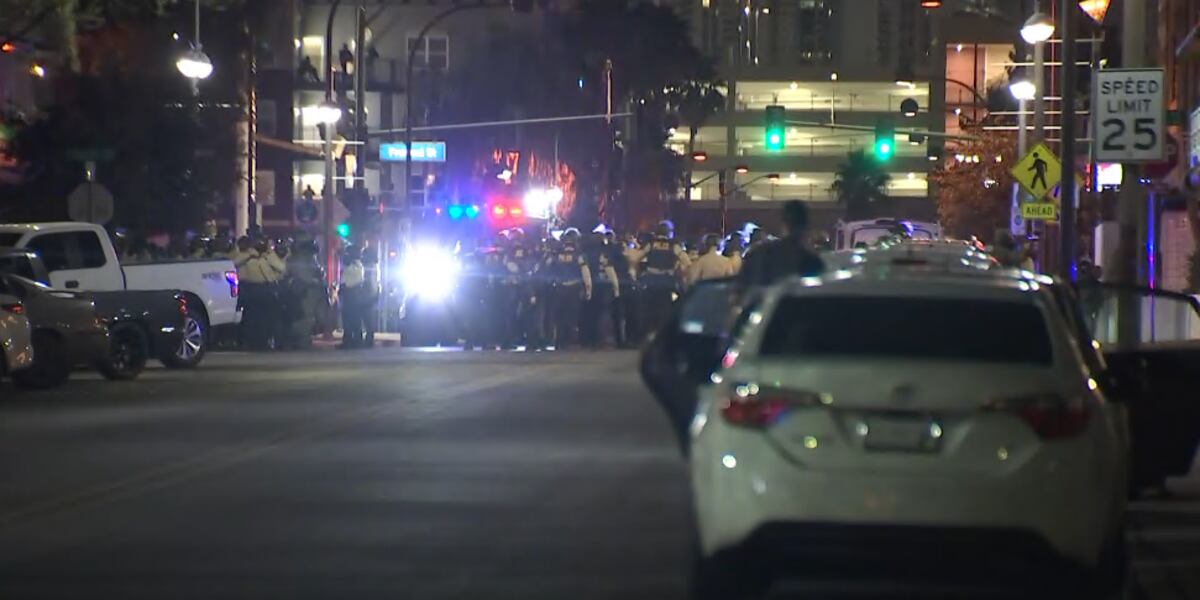

LAS VEGAS, Nev. (FOX5) – Officers took more than 90 people into custody last night after an immigration protest in Downtown Las Vegas swelled to the point where Metro ruled it illegal and moved in to shut it down.
Officers put on riot gear, armed themselves with pepper spray and rubber bullets, and dispersed the crowd.
Metro tells FOX5 the demonstration had to end after it became an “unlawful assembly.” And that made us wonder how exactly it became unlawful. So we’re getting answers from a Las Vegas Metropolitan Police Department deputy chief.
You saw it live as it happened on FOX5 Wednesday night – Metro officers shutting down a demonstration against recent ICE raids across the country.
The protest started on the sidewalk, but quickly spread into the streets.
”Oh, damn!”
A FOX5 photojournalist turned a corner and encountered a throng of protestors on a side street near the main gathering. Metro tells us that, at one point, more than 800 people were gathered in the area of Las Vegas Boulevard and Clark Avenue.
“As the crowd started to move, as you can imagine, that’s a large crowd, but as the crowd started to move we saw them overtaking the roads more and more often, and so at that point we addressed the crowd, we gave dispersal orders, and then we must take action at that point,” Deputy Chief Jose Hernandez told us during a live interview on
Metro makes the rules for protests clear on its website:
- Protestors must stay on the sidewalk unless permitted to use the street.
- They cannot block driveways, intersections, or roads without authorization.
- And they can’t interfere with the free flow of traffic or emergency vehicles.
“When you look at what happened last night, and you start to see how people in mass start to take over a road, at that point the entire event is considered unlawful,” said Hernandez
A protest also becomes illegal if participants become violent, commit vandalism, or make threats. Demonstrators can’t carry banned weapons or throw things. Nor can they block entrances to public buildings.
“At some point they were violent towards the police officers, throwing items at police officers. These are the things that deem gatherings like this unlawful, and at that point we must take police action, that is unlawful and we must disperse the crowds.”
If officers see anything illegal, they will give a “dispersal order” and tell people to clear out. They’ll give warnings when possible, usually in English and Spanish, and they may be delivered verbally, with or without speakers, or officers may use signs.
Failure to comply with a dispersal order is a misdemeanor and may result in an arrest.
“We are here to provide a safe environment for people to exercise their First Amendment rights, so long as it’s lawful, its peaceful. And so what we look for is to provide that service, however when things become violent, or they become unlawful, or the traffic infractions, violations are being violated, that’s when the officers must take police action.”
Deputy Chief Hernandez tells us Metro does send an engagement team to meet with protest organizers before these types of gatherings. He says they explain both the rules and the consequences clearly.
You can find a detailed list of rules for protests here.
Copyright 2025 KVVU. All rights reserved.