


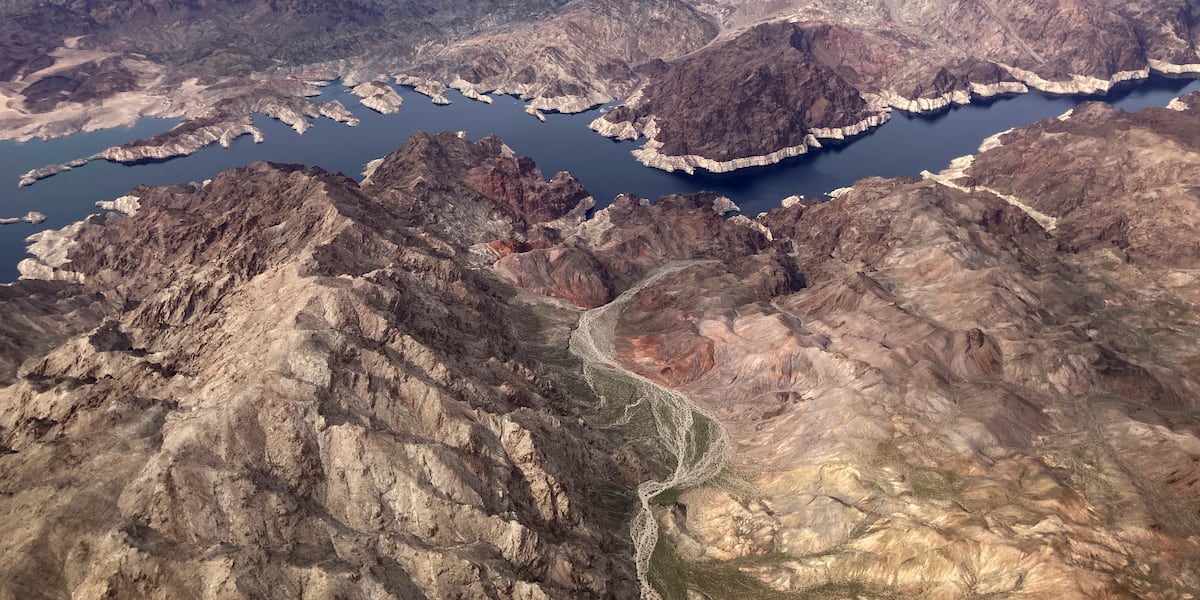

LAS VEGAS (FOX5) —A July report from the US Bureau of Reclamation makes some stark predictions about Lake Mead in the coming years.
Those predictions include water levels not seen since workers filled the lake back in the 1930s, but that doesn’t mean the Las Vegas Valley needs to worry about our water supply – plans for the worst are already in place.
“But really, depending on what the snowpack looks like over the next couple of winters, there is the potential that Lake Mead could hit its lowest elevation in recorded history.”
Bronson Mack, the Southern Nevada Water Authority’s Outreach Director, is talking about the dire possibility spelled out in the latest Bureau of Reclamation analysis.
“It hit a low elevation in 2022, at elevation 1,040, that the lowest Lake Mead has ever been, and right now, current projections show that sometime around the summer of 2027, Lake Mead could be in the 1,030s,” says Mack. “So we could see it lower than its historic level.”
He tells us the lake’s expected to remain at its current levels through the end of the year.
“Fortunately this year we are seeing lake levels up a little bit higher, a lot of that has to do with at least some better snow pack than we’ve over the past couple of years within the Colorado Rockies, but it’s coupled with the fact that Arizona, California, and Nevada have all taken steps to reduce their water demands on Lake Mead.”
In fact, the valley is considered a global leader in water conservation, with almost every drop used indoors recycled.
“There isn’t a single community that utilizes Colorado River water that has saved water to the level that we have done here in Southern Nevada,” says Mack. “And that’s just a testament to this community’s conservation efforts and to everybody doing their part to ensure the long-term sustainability of our water resources.”
Despite the community’s best efforts, the weather patterns have not been kind to the Colorado River. Without several strong winters, it will continue to shrink, and Lake Mead’s levels will continue to drop.
“Water levels in Lake Mead certainly can be problematic if they continue to decline. But our community has taken steps to help insulate Southern Nevada from those impacts,” explains Mack. “This is the development of Intake #3, a deep-water intake within the lake and the low-level pumping station. Both of those facilities are working in tandem right now to deliver water into this valley. And having that infrastructure in place really allows us to secure access to our Colorado River water supplies regardless of what Lake Mead’s elevation is.”
Mack says Las Vegas is the only Colorado River water user with that level of security. But he says the community’s conservation efforts thus far cannot go without recognition.
“That’s just a testament to this community’s conservation efforts and to everybody doing their part to ensure the long term sustainability of our water resources.”
For now, the valley and the rest of the Lower Colorado River Basin remain under Tier 1 water restrictions, thanks to an agreement between California, Arizona, and Nevada. However, that could change in the summer of 2026, unless weather conditions change dramatically.
Copyright 2025 KVVU. All rights reserved.