

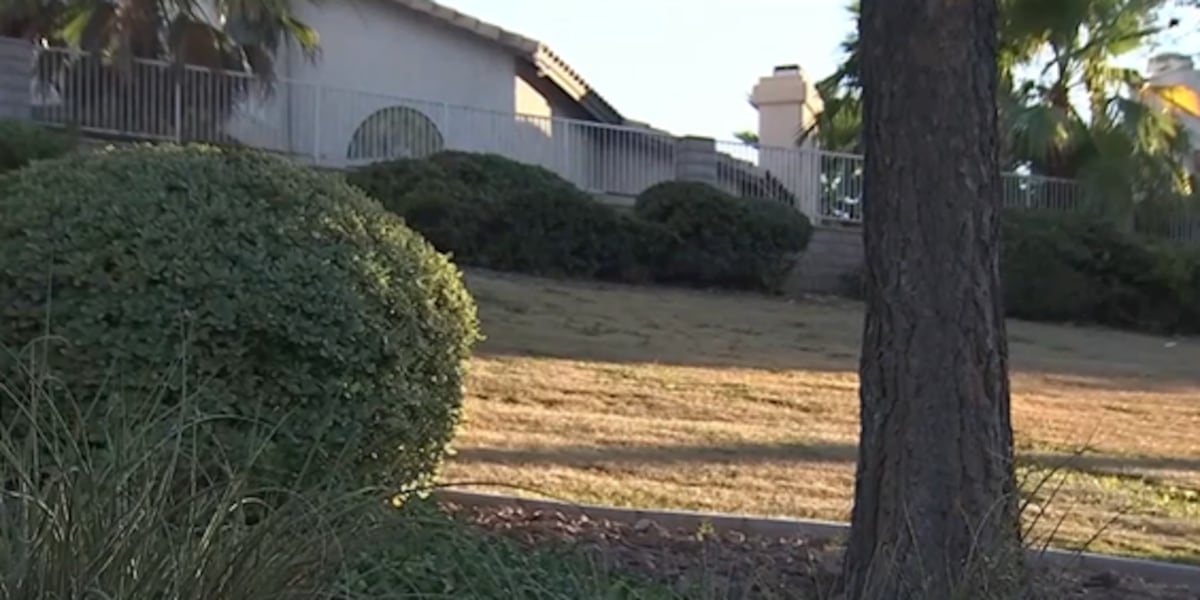

LAS VEGAS (FOX5) — West Las Vegas Valley neighbors are voicing concerns about grass removal across their neighborhoods and the impact on the health of trees.
FOX5 has extensively covered the drought, water restrictions, tree-planting incentives and concerns about the health of older trees.
By 2027, businesses and residential communities must remove “non-functional turf”: grass that has no recreational value. Assembly Bill 356, passed in 2021, mandates that no water from the Colorado River can irrigate non-functional, decorative grass.
As communities continue to implement turf removal measures, residents have voiced concerns over the visible aftermath: after grass is removed, some surrounding trees and plants are slowly dying.
Various residents voice concerns about the impact of the “heat island”: elevated temperatures in parts of the Valley that lack greenery.
Residents in The Lakes community off Sahara Avenue tell FOX5, neighbors signed a petition to urge the Las Vegas Valley Water District to allow stretches of grassy slopes to remain.
Thousands of square feet of turf have already been removed, residents tell FOX5; one anonymous neighbor voiced concerns that various remaining trees and plants were dying.
“This grass here used to be beautiful and green, and you would see families walking their dogs and families. It’s just not going to be as beautiful and we need nature. We need plants,” said concerned parent and resident Fawnia Mondey.
According to Bronson Mack of the LVVWD, a 205,000-square-foot grassy slope area in The Lakes consumes 25.5 million gallons of water a year – enough water for 200 households.
Just northwest of that area, one Summerlin resident voiced similar concerns before the LVVWD meeting, last week.
“There are around 200 [trees] in 0.4 miles that have died. You can drive there yourself. I would say please go and take a field trip there and look at this, and see what has happened right outside my neighborhood,” the resident said to the board.
FOX5 spoke to Bronson Mack of the LVVWD about the concerns. Mack explains, after grass removal, proper replanting efforts must occur.
“Certainly when you are making changes to grass landscapes, there is the potential for impacts to the urban heat island. This is why we require that, when grass is replaced in our Water Smart Landscape Program, that that grass be replaced with trees and plants that provide 50% canopy coverage,” Mack said.
“We need to protect those legacy trees that we have here within our Valley, but we also need to be thinking about succession plans for those trees that aren’t going to adapt to our higher, hotter climate in the future,” he said.
The Southern Nevada Regional Planning Coalition Regional Plant List shows what plants and trees are better adapted to a desert climate. Mack points out that various trees across the West Valley that are slowly dying are not drought-resistant.
Mack maintains that non-functional turf removal is critical for the long-term health of the Valley’s ecosystem.
It is purely aesthetic at that point, and that is the grass that is really just drinking our water supply. Replacing that grass with water-efficient trees and plants is going to save water. It’s going to actually provide more habitat for birds and for insects and for the wildlife that we have here,“ Mack said.
The Las Vegas Valley Water District has informed properties of the forthcoming mandates, actions needed, resources to replace that grass, and qualifying rebate programs.
The Southern Nevada Water Authority has a incentive for residents with grass: residents can get $100 for every new tree installed when grass is removed. Mack said that the programs urge installation of trees that are adapted to the desert climate.
Copyright 2025 KVVU. All rights reserved.