

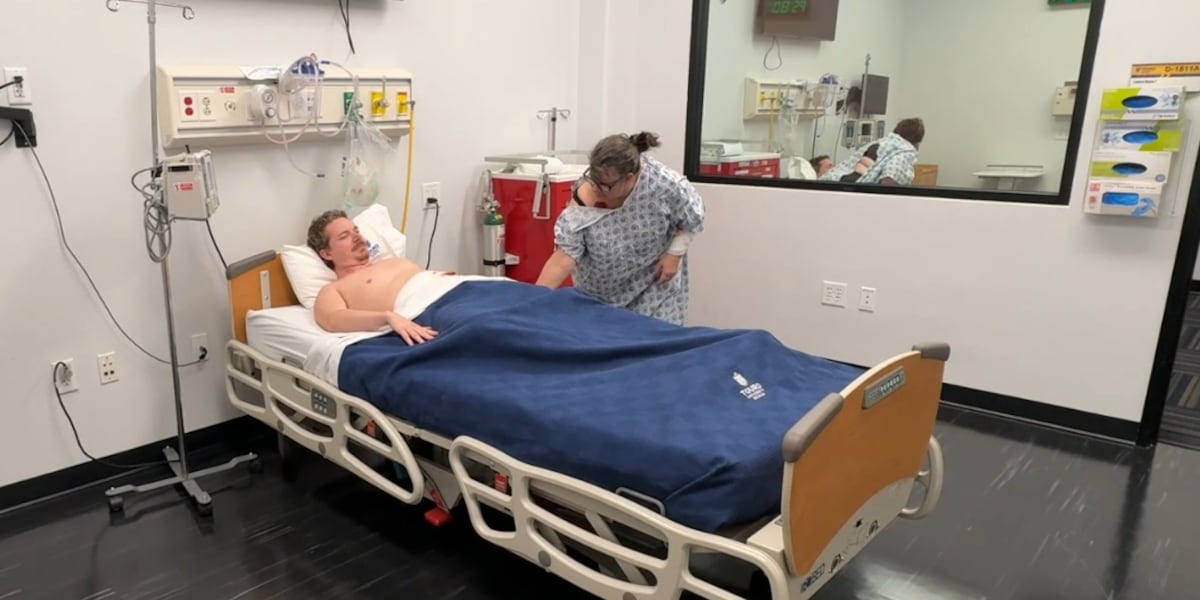

LAS VEGAS (FOX5) — Touro University in Nevada is using about 80 actors called “standardized patients” to help medical students learn specific skills before performing medical tasks on real patients.
The actors portray medical conditions to help students identify proper treatment methods. They play nurses or family members of patients as part of comprehensive training simulations.
The university combines human actors with advanced technology mannequins that can simulate heartbeats, bowel movements and provide AI feedback to students.
“Really, simulation is anything that you wouldn’t want to perform to you or I, but you would want to learn in a safe way before doing those skills or techniques on a real patient,” said Casey Maurice, director of clinical simulation for Touro University of Nevada.
Experienced actors bring Broadway skills to medical training
Lynn Eldredge lived in New York for over 25 years and worked on Broadway before bringing her skills to the medical simulation program.
“So I portray different diseases. A patient with a disease,” Eldridge said.
Alicia Borja, who served in the Air Force on active duty and has film acting experience, said the work provides direct interaction with future medical professionals.
“My favorite part about being a standardized patient is that I get direct interaction with the medical field’s future,” Borja said. “So I can see that what I’m providing as a standardized patient is really making an impact and helping students learn.”
Both Eldridge and Borja say they enjoy learning more about different medical conditions and treatment as well.
Program incorporates improvisation and realistic scenarios
Faculty works with simulation staff to write medical cases into templates for the actors since some simulated actors may not have medical backgrounds. Actors may use improvisation in training scenarios which can help prepare the students for various scenarios.
Maurice said the university has accomplished significant growth in the simulation program over the past five years under her leadership.
“Simulation is going to continue to grow,” Maurice said. “I can really build up my confidence or the students confidence with these skills without ever hurting, hindering, touching a patient.”
The university received accreditation a few years ago, which has helped increase simulations recently. The program is funded by institutional money and private donors who provide devices and technologies to the school.
Touro University conducts over 25,000 simulation hours per year. Standardized patients can apply to online job postings, ages range from 18 to 80 years old, and are paid, mostly part-time positions.
Copyright 2026 KVVU. All rights reserved.