



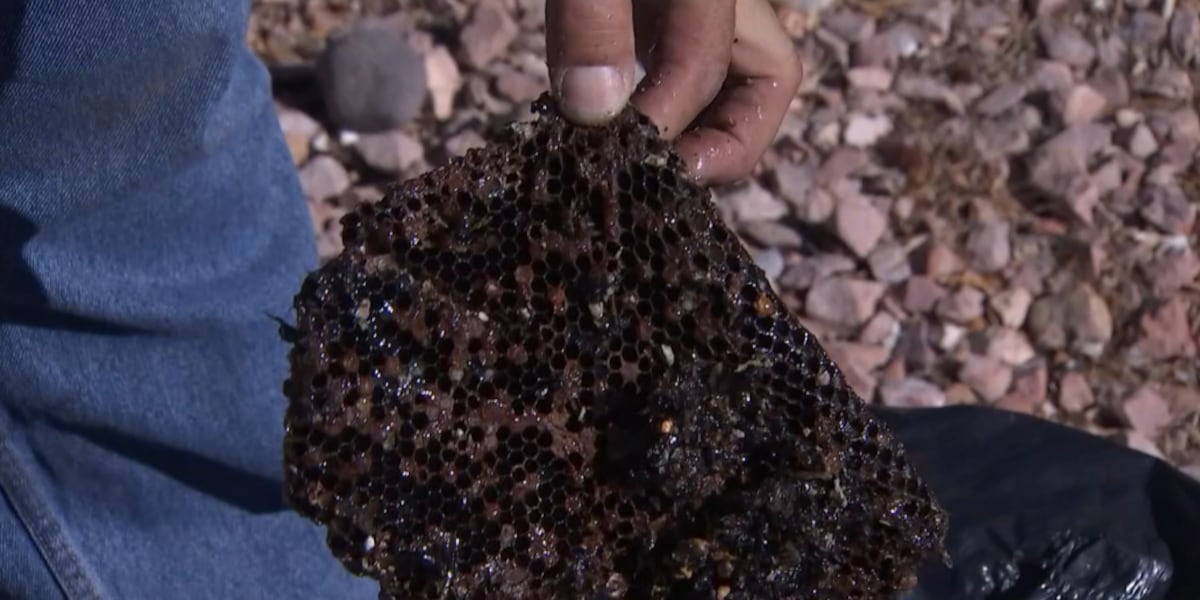

LAS VEGAS (FOX5) — Killer bees have been present for some time in Southern Nevada but remain a threat to public health, according to state officials.
FOX5 told you about the 86-year-old Henderson man who was stung hundreds of times; his dog did not survive dozens of stings. The culprits were killer bees, according to the company assigned to remove the bees from a vacant home in the Sun City Anthem neighborhood.
State officials tell FOX5, killer or “Africanized” bees have been found in Southern Nevada since the 1990s. In 2002, a “quarantine” was put in place to stop the movement of the species outside Clark, Nye and Lincoln Counties. They are now in 13 states.
“Africanized bees are defined as a ‘disease of honeybee colonies’ by Nevada law. If they’re encountered as a colony, rather than removing or relocating them, they should be destroyed to prevent the spread and further disbursement of Africanized bees,” said Ray Saliga, deputy administrator for the Division of Plant Health and Compliance for the Nevada Department of Agriculture.
“Africanized bees are a threat because of the increased aggression that they display and the tenacity which they’ll defend their colonies. It’s much greater than what a normal honeybee or a European honeybee colony would do,” Saliga said.
There are more than 100 native species of bees that remain a critical part of local ecosystems, according to state officials.
Though the Agriculture department takes samples from pest control companies, it would take a wide survey for the state to determine the full extent of the spread of killer bees, Saliga said.
The owner of local company The Bee Master of Las Vegas tells FOX5, he constantly removes killer bees from homes and businesses all across the Valley.
Daniel Millett generally gets calls after a swarm attacks a person or keeps someone from safely entering their home.
Experts say, killer bees multiply quickly.
“They’ve got this fantastic amount of bees in reserve to attack with, and that’s what makes them most dangerous: their genetics are predisposed to the African Savannah. If you imagine the big critters in the African Savannah: the rhino, hippo, lions, giraffe. Those are the things that come and eat a beehive. Their defense mechanism has been geared towards those,” Millett said.
What should homeowners do if they encounter a hive on their property?
“If you do see a large amount of bees, the first thing you should do is leave the area as quickly as you can. Put some distance between yourself and the colony. If they do not disperse, then hiring a licensed pest control company would be the best move to gauge that colony,” Saliga said.
It’s difficult to visually tell the difference between a killer bee and other honey bee species; it would take an entomologist to examine specimens under a microscope.
A telltale sign of a killer bees for the average person: a massive, aggressive swarm.
If you are confronted by killer bees and a swarm, run a quarter of a mile away.
“Distance is really the only way to have the bees see that there’s no longer a threat and to leave you alone,” Saliga said.
Some “don’ts” when confronting killer bees: spraying them with water or a substance will only aggravate them, Saliga said. Jumping in a pool does not help; the bees will wait for you to emerge.
You can find a list of licensed pest control companies through the Nevada Department of Agriculture.
Copyright 2025 KVVU. All rights reserved.