


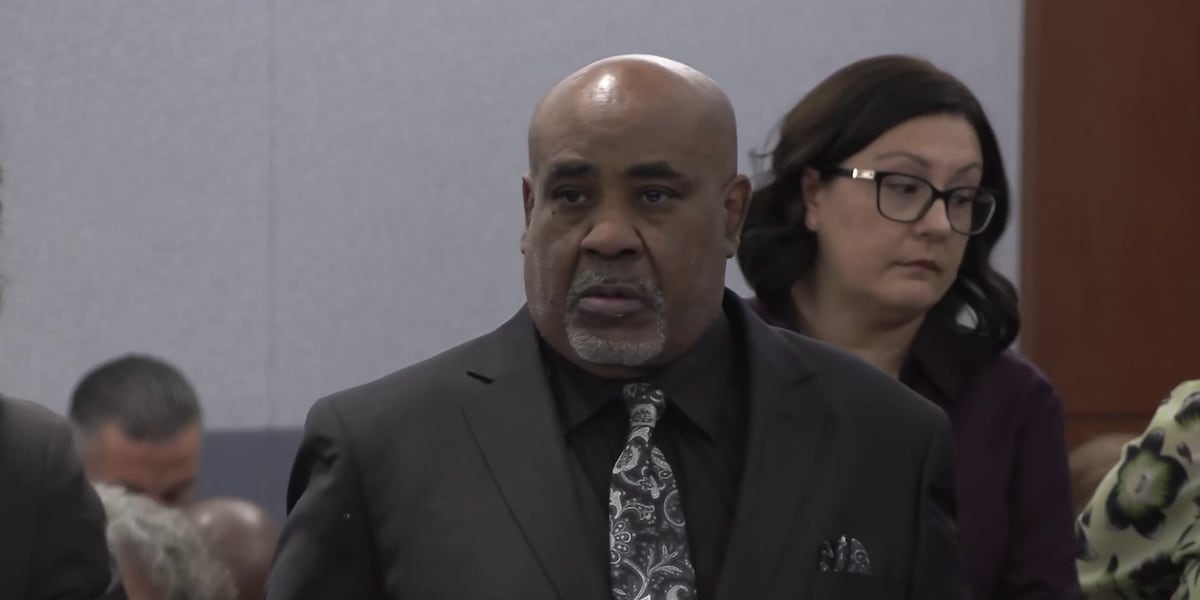

LAS VEGAS (FOX5) — Closing arguments are expected to begin on Monday as the Tupac murder trial enters its final week.
Good morning. Closing arguments are set to begin in the Tupac murder trial. I am in the courtroom. Tupac’s family is in the front row as they have been throughout this trial- sitting behind the prosecutors. Follow this thread we get more info @FOX5Vegas
— Victoria Saha (@VictoriaSaha) August 31, 2026
Live updates
9:07 a.m.
Jury begins to walk into the courtroom.
9:10 a.m.
Clark County District Court Judge Carli Kierny begins reading jury instructions.
The 52 formal jury instructions established the strict legal boundaries jurors must navigate to decide the fate of Duane “Keefe D” Davis.
Some of those instructions were laid out as:
- Davis is charged with first-degree murder. To convict, the jury must be unanimous on his guilt, but they do not have to agree on his exact role. Davis can be held legally responsible as the direct principal, an accomplice who aided and abetted, or a co-conspirator.
- Under conspiracy laws, Davis is criminally liable for any crimes committed by group members that were intended or reasonably foreseeable.
- According to the instructions, first-degree murder is a specific intent crime requiring premeditated and deliberate intent to kill. Second-degree murder involves malice but lacks premeditation. If the jury believes murder occurred but has reasonable doubt about the degree, they must default to second-degree.
- Jurors must discard Davis’s past police statements if they find they were coerced by law enforcement. However, statements made out of self-interest or the expectation of a benefit are legally considered voluntary.
9:34 a.m.
Judge finishes jury instructions. State proceeds with their closing statements.
9:38 a.m.
“This notion of corroboration does not exist in the law its absolutely untrue,” Clark County District Attorney Binu Palal says during the state’s closing arguments.
Defense attorney Michael Sanft requested a sidebar with the judge, though no explanation was provided after the brief discussion.
“Mr. Davis confessions are direct evidence of a crime. This case is drenched with circumstantial evidence.” Palal continues.
10:27 a.m.
Court takes recess and is expected to return at 10:40 a.m.
10:42 a.m.
Jury returns and the state returns with their closing argument.
Prosecutors continue to paint Davis as a “shot caller” who spent years boasting about his role in the murder.
Challenging defense claims that Davis’s past confessions were fabricated, the state pointed to his own book, interviews, and public statements where he actively promoted his involvement.
Prosecutors end their closing argument by making the following statement:
“For nearly 18 years, Duane Davis has told police, television networks, book authors, YouTube interviewers, and anyone who would listen that he is responsible for the murder of Tupac Shakur. Tell him you hear him. Find him guilty.”
11:08 a.m.
Court takes another recess before the defense begins their closing statements.
Out of the presence of the jury, it is revealed Davis is not feeling well. Judge then asked if he can have cough drops.
11:28 a.m.
Jury returns and the defense begins their closing argument.
One of Sanft’s opening remarks begins with the question, “Why are we even here 30 years later IF Duane Davis truly confessed?”
He then begins focusing on the missing reports and compromises during the investigations. He highlighted how detectives had to lock files in desks and create decoy case numbers to prevent unauthorized officers from leaking information to the media.
The defense also challenged the state’s motive theory, which claims a massive gang war was triggered by a violent brawl at the Lakewood Mall during the summer of 1996.
Sanft added that police had no record of the fight, with no 911 calls, mall security logs, or insurance claims to back it up.
Sanft further mentions the reliability of Davis’s past statements, comparing them to the accounts of actual eyewitnesses who were in the caravan with Tupac Shakur on the night of the shooting.
While Davis previously claimed they spotted the rapper because crowds were screaming his name, eyewitnesses testified under oath that the street was quiet and Tupac was sitting quietly inside the vehicle.
Replaying video of Davis standing at the intersection of Flamingo and Koval, Sanft argued his body language was inconsistent with someone who had actually been present at the scene.
The defense details how the state’s witnesses were subpoenaed and admitted they did not want to testify.
Sanft continued to argue that the state failed to call key individuals who actually should have been there, including Suge Knight, Det. Mogg, Foxy Brown (an artist mentioned in Keffe D’s book), Big Meech of Detroit (an individual also mentioned in Keffe D’s book), Yusef Jah, and former LAPD detective Greg Kading.
Sanft later focuses on Kading again, who was removed from the Biggie Smalls task force, accusing him of stealing the Tupac file for profit.
Sanft emphasized that while the state repeatedly labeled Davis a “shot caller,” there is zero evidence he ever ordered a hit before or after Tupac’s death.
Stay with FOX5 for live updates.
Copyright 2026 KVVU. All rights reserved.