


LAS VEGAS (FOX5) — The Pierce Autism Center at Touro University is expanding its Imagination Room, a space designed to help children with autism practice everyday skills in a controlled, low-stress environment.
The center serves children from 18 months through 18 years. Staff said the goal is to help them build confidence for real-world interactions.
Jennifer McConnell, a board-certified behavior analyst at the center, said the primary population the center serves is children with autism spectrum disorder. She said the center also serves clients with fetal alcohol syndrome and other diagnoses related to ADHD, OCD and anxiety.
What the room includes
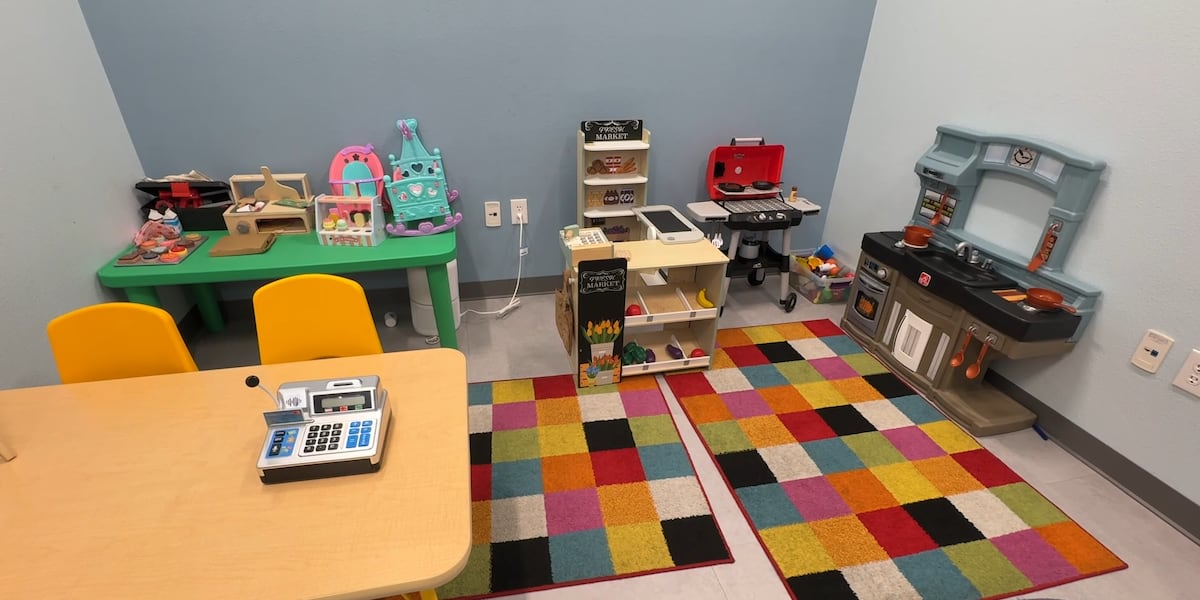
The room includes settings children may encounter with their families, including a grocery store, kitchen and grill.
“Our Imagination Room is a room that is full of things that you would see in the real world,” McConnell said.
She said children can imitate what they see their parents or siblings doing and practice communication, taking turns and interacting with one another. Therapists also use the spaces for role-play.
“Having a room like this, as opposed to just having a regular clinic, means that kids can have an environment where they can practice skills and use their imagination and take these skills and generalize them into other settings,” McConnell said.
MORE ON FOX5: LEGO club helps Las Vegas valley students build friendships
How sessions work
McConnell said a session starts with choosing a location, such as the grocery store, and practicing different roles. She said imaginary play can be difficult for children on the autism spectrum.
“Not because they don’t have a vivid imagination, but because it’s the different social roles that they live by,” she said.
Imitation is also one of the skills practiced in sessions.
“A lot of children on the spectrum don’t often know how to read a room and how they’re supposed to act amongst their peers,” she said. “So, if they can imitate the skills that they see, they can then replicate that and fit into the environment.”
McConnell said therapists use items that look like those children will find in a real setting. She called these “common stimuli.” In the grocery store, children practice purchasing items and using a cash register.
“So, practicing with very detailed objects makes it easier to generalize the behavior so that when you go into a real setting, it’s just a second nature,” McConnell said. “They’ve seen it in a low-stress environment.”
McConnell said starting young matters.
“When kids are little, they’re sponges and they take in this information,” she said. “So, the younger we start, the better.”
Feedback from families
McConnell said waiting and taking turns are among the main skills the center works on. She said children start with short periods of waiting and build up tolerance.
“Parents are very pleased as we talk about some of the different social interactions their children have had,” McConnell said. She said parents have told staff the skills carry over to other environments at home and at school.
“I think that’s the best part of the Imagination Room, because this room is all about fun and playing,” McConnell said. “They’re learning, but they don’t know that. It’s a chance for them to be able to play and interact in a natural way where the stakes are very low, but they can learn the skills that they’re going to implement in real-world environments.”
McConnell also spoke about play and screen time.
“We know that we’re living in a time where there’s a great divide between screen time and play time, and we have to remember the importance of play and getting back to the basics and how important it is to help our children learn and grow,” she said.
The center also offers social-skills groups for children ages 10 to 18, including evening sessions after school. McConnell said children in the groups practice communication, social interactions and friendship.
Giving Tuesday donations
The center said donations this Giving Tuesday will help pay for new items in the Imagination Room.
“This Giving Tuesday, we are looking to add to our Imagination Room,” McConnell said. “Any donations will go to purchasing new items for the kids, and to build upon our dream that we have.”
“Your donation will give people the opportunity to play and to practice in environments that are very similar to real world, but are very safe,” she said.
Copyright 2026 KVVU. All rights reserved.