


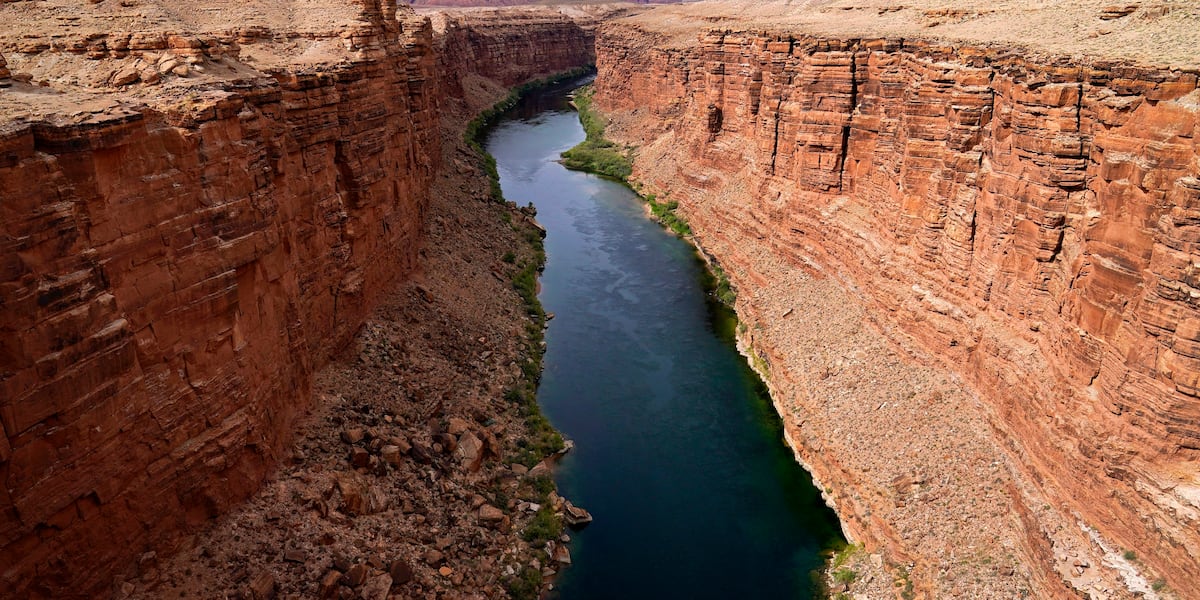

LAS VEGAS (FOX5) — The Bureau of Reclamation has released a final environmental review that lays out how the federal government plans to manage the Colorado River for the next decade.
The document — called a Final Environmental Impact Statement, or EIS — establishes a flexible decision-making framework to guide water operations at Lake Powell and Lake Mead through 2036.
MORE ON FOX5: Colorado River Basin states await federal water plan
Rather than locking in fixed rules, the framework sets boundaries, called “sideboards”, within which federal managers can adjust water operations based on actual conditions each year. Those boundaries include:
- Annual water releases from Lake Powell between 5 million and 12 million acre-feet — an acre-foot is roughly the amount of water needed to cover one acre of land one foot deep, or about 326,000 gallons
- Water shortage reductions for the Lower Basin states of up to 3 million acre-feet
- The ability to store up to 8 million acre-feet of conserved water in Lake Powell and up to 3 million acre-feet in Lake Mead for future use
- Voluntary water conservation in the Upper Basin of up to 200,000 acre-feet, depending on water supply conditions
Within those boundaries, the federal government plans to issue updated operating guidelines roughly every two years. The framework also leaves room for the seven Colorado River Basin states to reach their own consensus agreements, which could then be folded into future operations.
“The Department has a responsibility to ensure the Colorado River system remains reliable and resilient for the millions of Americans, communities and industries that depend on it,” said Interior Secretary Doug Burgum. “This framework provides the flexibility to respond to changing hydrologic conditions while preserving the opportunity for the Basin States to continue working toward durable, consensus-based solutions.”
The federal review process began in June 2023. Over three years, Reclamation gathered input from states, tribes, federal agencies, and the public. After a draft EIS was released in January 2026, the agency received more than 18,000 comments, including 785 unique submissions. That input was used to shape the final preferred alternative.
“This plan strikes a balance between flexibility and predictability for the Colorado River system that is vital to the 40 million people who rely on it,” said Assistant Secretary for Water and Science Andrea Travnicek.
A separate international process governing water deliveries to Mexico is ongoing.
Copyright 2026 KVVU. All rights reserved.