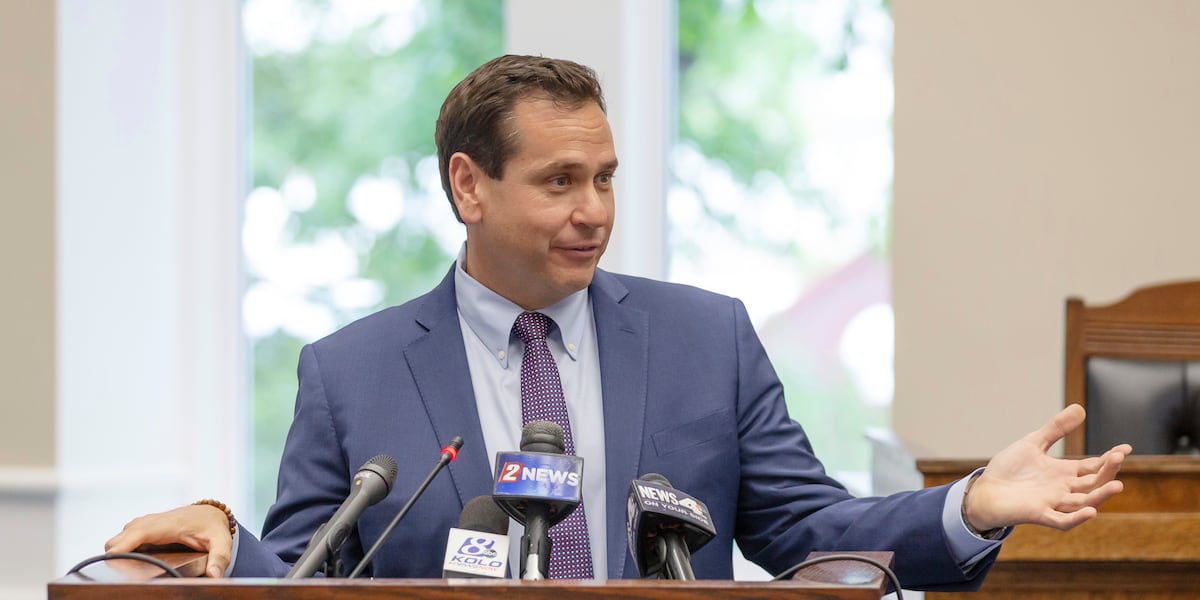



LAS VEGAS (FOX5) — As early voting in Clark County approaches, Nevada’s Secretary of State Francisco Aguilar spoke with FOX5 about upgrading voting systems, defending election security, and his ongoing dispute with the Department of Homeland Security about claims of “non-citizens” registering to vote.
The State of Nevada has officially entered the 90-day blackout period before the general election, in which changes cannot be made to the voter roll.
In an interview Thursday, Aguilar says his office worked with all 17 of Nevada’s counties to ensure voter rolls were up-to-date.
MORE ON FOX5: Nevada Secretary of State highlights election information tools
Aguilar also says that voting system upgrades were implemented ahead of this election cycle, including upgrades to their statewide voter registration and election management system called VRAMS.
This system replaced multiple, separate systems run by each individual county in 2024 after the state legislature mandated it.
Other new changes for the upcoming election include new ballot-marking devices, which will not store voter information internally.
At the polls, he said voters can expect to check in, receive a card, vote on the machine, verify their selections and receive a printed paper ballot, which becomes the official record of the vote.
Voters then insert that paper ballot into a tabulator, where it is stored and counted.
Aguilar said the new machines reduce the number of flash drives used at polling locations. He said a polling location with 50 machines previously required 50 flash drives to be secured; now, only the tabulators — typically two or three per location — contain flash drives.
Signature verification process
Aguilar said every mailed ballot returned to a county is scanned using either a BlueCrest or Agilis machine. He said 30% of ballots receive a positive signature match through that scan, compared against signatures on file from voter registration forms, the Department of Motor Vehicles and previous elections.
The remaining 70% go to bipartisan review, in which two people from opposite political parties compare the ballot signature to the signature on file, according to Aguilar.
If both agree the signatures match, the ballot moves into processing. If they disagree, the ballot goes into the “signature cure” process, which allows the voter to provide needed corrections.
Universal mail ballots
Aguilar said Nevada’s universal mail ballot system serves a diverse population, including workers in 24-hour economies such as gaming in Clark County and mining in northeastern Nevada. He said Nevada’s elections were ranked second in the country by MIT for security, accessibility, voter experience and transparency.
Aguilar said 60% of Nevadans participated in the recent primary using mail ballots, and that Douglas County and Nye County have the highest rates of mail ballot use in the state. He said Clark County’s ballot this cycle will be two pages long with 70 judicial races.
He said mail ballots returned as undeliverable because a voter has moved trigger a process to inactivate that voter’s registration until the voter confirms an updated address or confirms they remain registered in Nevada.
Aguilar encouraged voters to return mail ballots addressed to people no longer living at that address so counties can update voter information, and to visit vote.nv.gov to verify their registration information.
Dispute over noncitizen voter data
In the past few months, Aguilar’s office has had extensive back-and-forth with the Department of Homeland Security about claims of “non-citizens” registering to vote in Nevada.
On July 16, DHS alleged in a letter to Aguilar and other Nevada leaders that around 15,903 noncitizens have been illegally registered to vote, which Aguilar’s office immediately disputed at the time.
Nevada’s Chief Deputy Attorney General Greg Ott sent the latest response letter to DHS on Wednesday, Sept. 23, saying the agency still had not provided Nevada the information needed to verify those claims.
According to the letter, DHS officials met virtually with Nevada election leaders to then say they had identified 185 individuals believe to be non-citizens following a manual review of Nevada’s voter file from July 2025.
They also said they were still reviewing their initial figure of 15,903 voters.
DHS followed up in August by sending a spreadsheet identifying those 185 voter case numbers, and adding that they were still reviewing over 6,218 additional case numbers. When election officials asked DHS for addition information, DHS responded that it would “prefer to limit our information sharing to just providing you the voter ID from your public voter list.” Nevada replied the same day that it was “unable to conduct an analysis without real verifiable information.”
On Sept. 9, 2026, DHS sent an email describing matching criteria used to generate the 15,903 figure, stating that the more attributes that match, the higher the confidence level of a match.
According to Nevada’s letter, DHS did not indicate the number of matching criteria or confidence level for individuals on the list, and DHS has not provided Nevada with the full list of 15,903 individuals.
Nevada’s letter states that its records indicate the 185 individuals DHS identified are citizens.
Nevada election officials further explained in the letter that DHS’s spreadsheet used “voter case numbers,” which Nevada says are voter registration numbers — administrative identifiers linked to a registration record, not proof of identity or citizenship.
The letter states that Nevada recently transitioned from county-run voter registration databases to a single statewide system, and that voters were assigned new state voter identification numbers during that transition.
As a result, according to the letter, the same number may have been associated with different voter records at different points in time.
Nevada’s letter states the state will continue to follow the National Voter Registration Act, the Help America Vote Act and state laws governing voter list maintenance and eligibility.
Copyright 2026 KVVU. All rights reserved.