

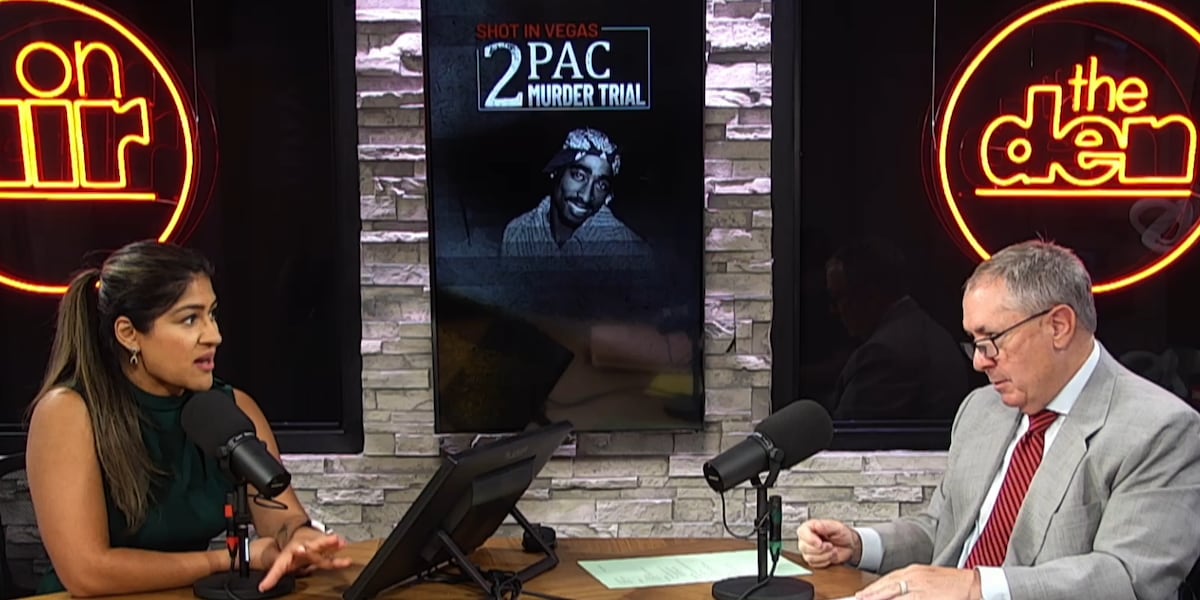

LAS VEGAS (FOX5) — Jury selection is underway in the murder trial of Duane “Keffe D” Davis, the man charged in the 1996 killing of rapper Tupac Shakur, and a former Clark County district attorney says the defendant’s own memoir ‘Compton Street Legend’ will be the focal point of the case.
Seventy-five prospective jurors reported Monday, Aug. 10, for the first day of selection. An additional 75 are expected Tuesday. The process is anticipated to last one week.
David Roger, who served as Clark County DA from 2002 to 2012 and previously handled capital murder cases in the office beginning in 1987, sat down with FOX5 ahead of trial to discuss what to expect as the case moves forward.
MORE ON FOX5: Inside the Courtroom: Jury selection continues in day two of Tupac Shakur murder trial
‘The book will be the focus of the trial’
Davis is accused of providing the murder weapon and directing the shooting that killed Shakur on the Las Vegas Strip following a Mike Tyson fight on September 7th 1996. Roger said the case against Davis hinges almost entirely on Davis’s own published account of the night.
“This book will be the focus of the trial,” Roger said. “Because that is Duane Keffe D’s admission — everyone else is dead. His nephew is dead, two other individuals in the vehicle are dead.”
Roger said now that the court has ruled the book admissible, the defense is expected to argue the account is fiction or embellishment written to sell copies, while prosecutors will work to corroborate its contents with other evidence.
In a recent jailhouse interview with FOX5’s Victoria Saha- Davis told her he did not write the book.
“The defendant is trying to sell a book and in order to sell the book he has to embellish,” Roger said, describing the anticipated defense argument. “And the prosecution is going to point to everything in the book, corroborate with other evidence.”
How Davis’s own words became the case against him
Roger explained that Davis originally spoke to investigators years before the book was published under what is known as a “queen for a day” letter — a form of limited immunity that allowed investigators to question him freely in exchange for information, without those statements being used against him in court.
At the time, Davis was facing significant drug charges in Southern California. Roger said Davis provided details about the murder during that interview, which helped him avoid prosecution on the drug case.
“Had he kept his mouth shut he would have never been prosecuted,” Roger said.
Roger said the situation changed when a detective who conducted the interview later wrote a book and participated in a documentary about the case. Roger said Davis then wrote his own book, which became the basis for his arrest and prosecution.
“It is his book that is the noose that is going to hang him,” Roger said.
Self-defense, conspiracy, and the 30-year gap
Roger addressed the possibility of a self-defense claim, noting Davis wrote in his book that Shakur reached for a weapon before shots were fired. Roger said while Davis may have inadvertently created that defense argument in his own writing, it is unlikely the defense will pursue that strategy at trial. He noted that when officers responded to the scene, the car carrying Shakur was secured and no weapons were found inside.
On the question of criminal liability, Roger outlined two legal theories prosecutors are expected to use — conspiracy and aiding and abetting — either of which can make a person equally responsible for a crime even if they did not fire the weapon.
Jury selection and media pressure
Roger said jury selection in a high-profile case is often less difficult than it appears. He cited the Nevada Supreme Court standard, which holds that the issue is not whether a potential juror has heard of a case, but whether they can set prior knowledge aside and decide based only on the evidence presented at trial.
“You would be surprised how little people retain about a case — a high profile case,” Roger said. “They may say yeah, I remember something about this rapper being shot in front of the hotel, but I think you are going to find a lot of people won’t remember a lot of details.”
Roger also addressed the court’s decision on jury sequestration, saying the court ordered partial sequestration — meaning jurors will eat and travel together — rather than full sequestration, which he said can be costly and cause jurors to become resentful.
On the question of media pressure, Roger said prosecutors need to make a deliberate choice to stay off camera and focus on case preparation. He referenced his experience handling the O.J. Simpson robbery case in Las Vegas, saying outside attention did not affect the proceedings because the evidence was straightforward.
“If you stay focused on your case and work on preparation it’s easy, but you have to make a conscious decision,” Roger said.
Will Davis testify?
Roger said there is minimal chance Davis will take the stand. He explained that if Davis does not testify, the jury will not learn during the guilt phase of the trial that he is a convicted felon. If Davis testifies, that information becomes available to prosecutors for impeachment purposes.
Roger said the outcome of a defendant’s testimony can go either way — if a defendant performs well on the stand and cannot be effectively impeached, it can make a conviction harder to secure. If the defendant struggles, Roger said, a conviction becomes far more likely.
Previously Davis told FOX5 he will testify if he has to.
Copyright 2026 KVVU. All rights reserved.