

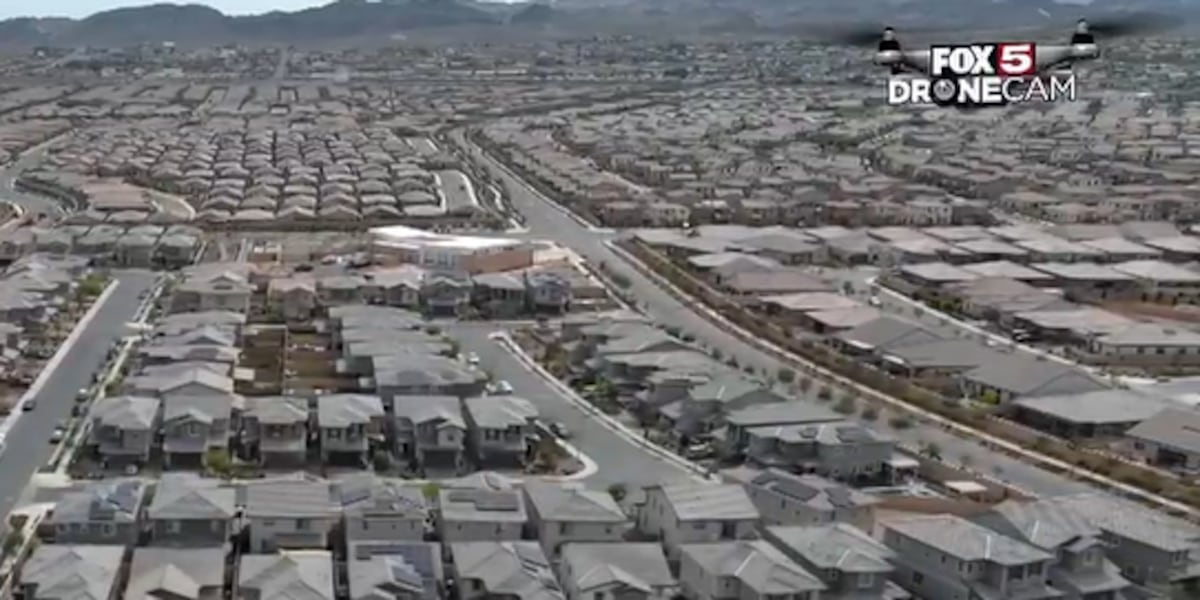

LAS VEGAS (FOX5) — Experts predict nearly 400,000 people will move to the Las Vegas Valley over the next 10 years.
Gov. Joe Lombardo joined developers, realtors, policymakers and researchers today to look for ways to build homes for all of them, while confronting the reality that the Valley lacks affordable housing for all the people who live here right now.
Recent estimates from Clark County show the area needs between 80,000 and 96,000 affordable rental units. In fact, between 2019 and 2023, the number of vacant, available units for rent or sale dropped from 45,299 to 33,670, while the population continued to grow.
Only about 36,000 acres of privately owned, developable land remain in the valley.
The Valley is surrounded by thousands of acres of federal land, some of which the government may make available for development. Part of today’s summit revolved around how that might be handled.
Land availability poses challenges
“We see these large swaths of land and even aside from the BLM ownership situation, you know, there might be grading issues. There might be other things, infrastructure issues that the average person doesn’t really think about that cause challenges,” said Andrew Smith, president of Home Builders Research. “So those areas are possibilities, but it really takes kind of a deep dive on each one of those different areas to really know what the challenges and the benefits are.”
Lombardo has urged the federal government to open more BLM land to development. But Smith said only some of that land is feasible when you consider access to necessary infrastructure.
While land may be more plentiful and affordable in less-populated, more remote parts of the state, the cost of connecting to water and electricity may make these locations more expensive in the long run.
Valley underbuilding housing units
“We’re actually underbuilding. The supply of housing units is way below where it needs to be,” Smith said. “Obviously, affordability is a part of that. The land constraint is a major part of it.”
Smith said the valley is building much less than it has for the past 30 years.
“People want to be here. Businesses want to be here. Home developers want to put a new, you know, master plan community or whatever it is,” Smith said.
Population growth strains land supply
Shawn McCoy, executive director of the Lied Center for Real Estate at UNLV, said current forecasts predict about 380,000 people moving to the Southern Nevada region over the next 10 years.
“To help you contextualize how big that population growth is, that increase in population is larger than the current population of both the city of Henderson and the city of North Las Vegas,” McCoy said.
“Where we stand right now with vacant, developable land is the crux, is the pinch point of where our economy stands,” McCoy said.
McCoy said the region needs housing and larger employment parcels to help develop commercial real estate to bring in businesses and jobs.
“What’s going on in the local land market is these big parcels are drying up quicker. We’re seeing those parcels become less and less available, which is making it increasingly more difficult to attract those large commercial assets, which may be hitting that job sector over the next three to five years,” McCoy said.
The 2026 Las Vegas Housing Outlook summit was hosted by Home Builders Research and Summerlin. Speakers included Tina Frias, CEO of Southern Nevada Home Builders Association, Steve Hill, CEO of Las Vegas Convention and Visitors Authority, and Zane Marshall, director of water resources for Southern Nevada Water Authority.
Copyright 2026 KVVU. All rights reserved.