
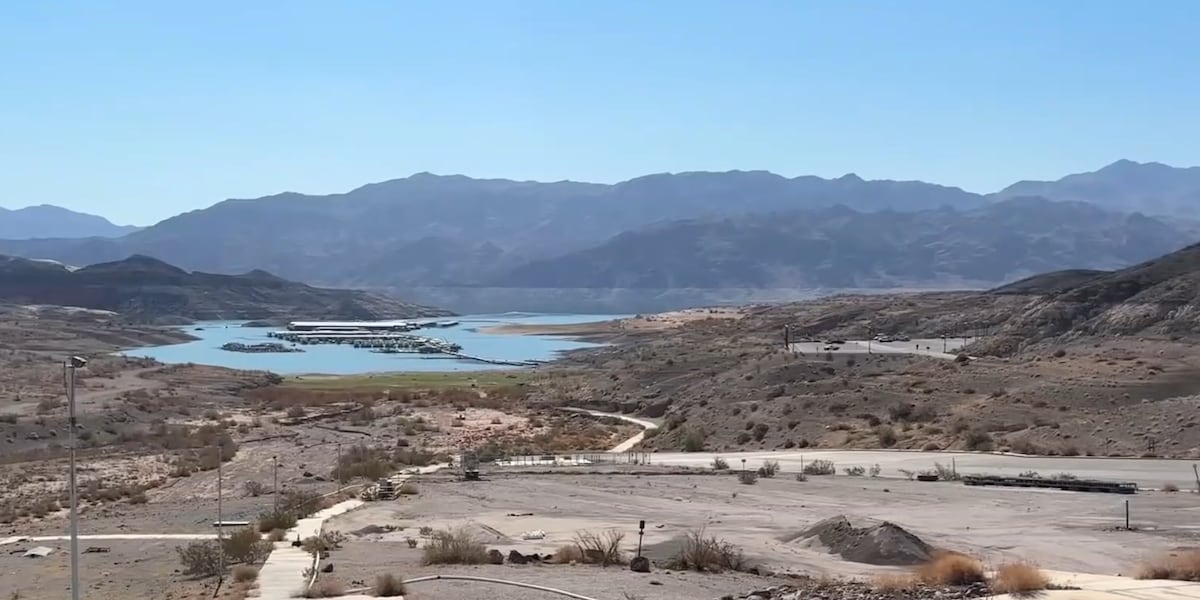



LAS VEGAS (FOX5) — As water levels across Lake Mead continue to decline, operations at Callville Bay Marina have become a continuous balancing act of moving docks, adjusting utility lines and repositioning underwater anchors.
For longtime boaters like James White, who has visited Callville Bay for 36 years, the landscape has transformed dramatically over the decades.
“It used to be able to launch way up over the building where the marina was,” White said.
Today, launching a boat requires a longer trek from parking areas down to the water’s edge. The marina now operates a shuttle service to transport boaters back and forth between their parked vehicles and the water once vessels are off trailers. Another regular boater noted that since the start of the current boating season, the shoreline has visibly dropped, estimating the water was about 10 feet higher just months ago.
MORE ON FOX5: 24-year-old motorcyclist killed in Southwest Las Vegas crash
Engineering a floating facility
Following more than two decades of drought that pushed Lake Mead to record lows, marina personnel manage a constant schedule of physical adjustments.
“So typically on a maintenance schedule you’re continually moving the marina with small fluctuations of a foot or two here and there throughout the year,” said Chad Taylor, director of operations and hospitality for West Coast Properties.
While the shrinking lake creates logistical hurdles, Taylor said the challenges remain manageable. The most demanding and costly aspects involve extending and maintaining essential utility infrastructure.
“The most expensive challenge is your water, your power and your sewer to keep the moorage clients out there that has to keep moving,” Taylor said.
The entire marina complex is held in place by three-quarter-inch steel cables connected to massive underwater anchors, regulated by heavy winches mounted along the docks.
“So here’s your winches,” Taylor said. “So, this is what attaches to the big anchor that you saw, and these are a three-quarter inch cable and these come in and out and essentially go out either side, and that’s what’s holding us right here on the dock.”
Moving 15,000-pound anchors and utility networks
For minor shoreline fluctuations, crews adjust cable tension across various winches. However, larger moves require moving the 15,000-pound anchors themselves—a multi-day operation requiring floating cranes and commercial divers.
Whenever the facility is pushed deeper into the bay, all utility connections—including fresh water, power and sewage lines—must be lengthened. More than a decade ago, operators constructed a floating fuel station that moves in tandem with the docks, allowing fuel tanker trucks to drive directly to the dock’s edge and connect supply pipes.
Among the most technical requirements during any relocation is the marina’s fire suppression system.
“It needs to remain in about 25 feet of water,” Taylor said, noting that deep water remains sufficient in the bay to maintain all safety operations.
Despite the changing shoreline, operators emphasize that Lake Mead continues to offer ample navigable water for recreational activities, accommodating everything from large houseboats to personal watercraft.
Copyright 2026 KVVU. All rights reserved.